01 · State
Continuous Pressure & Barrier State
Pressure, flow, influx, fluids, barriers, and equipment state persist through the complete well-control event.


Start with IADC-approved simulation content and IWCF-aligned training workflows today. Extend the same deterministic RuntimePhysics™ platform into advanced drilling, intervention, MPD, procedure validation, HIL, and digital twin workflows, without changing systems.
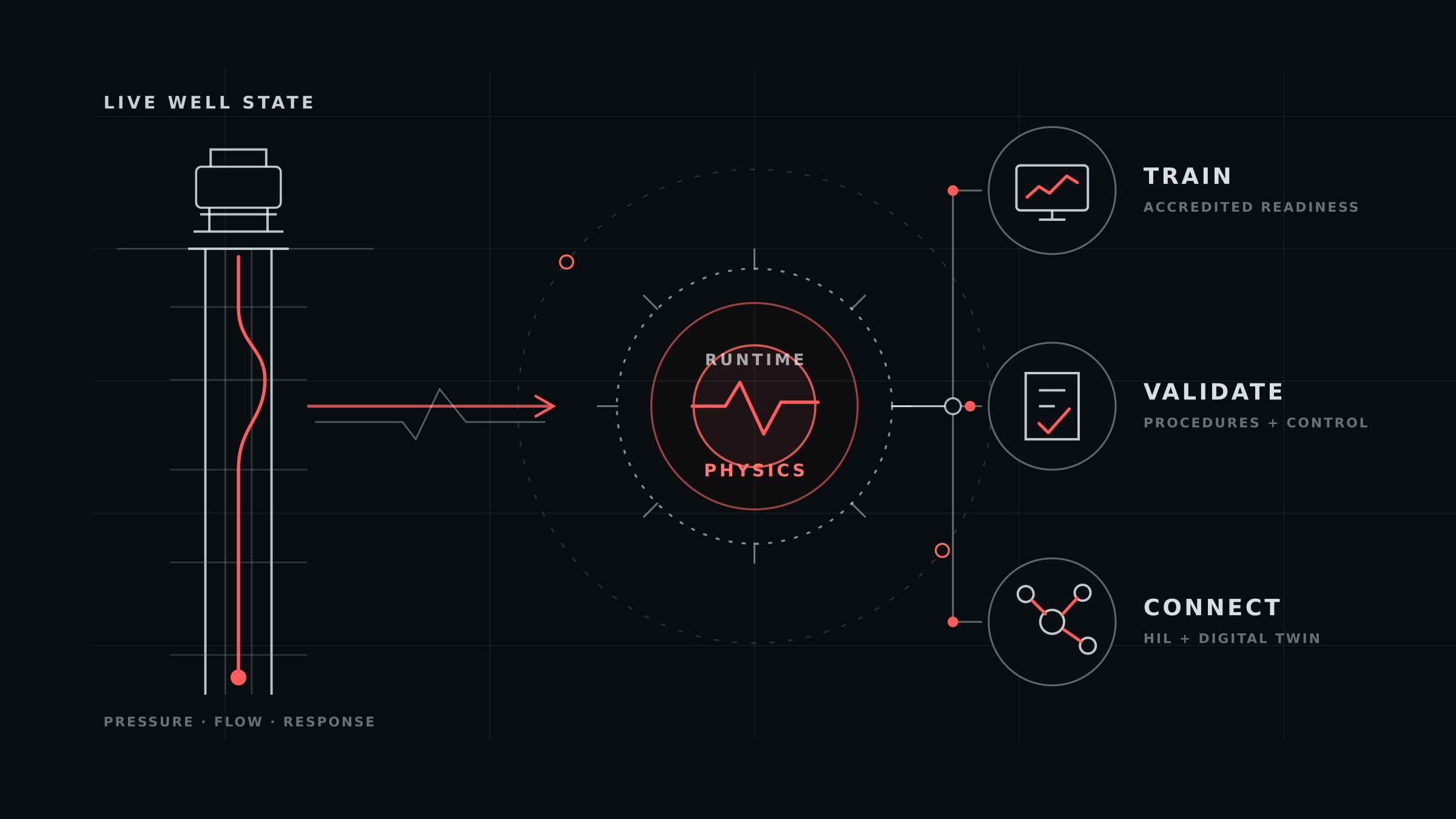
Well control is where many organizations first encounter Endeavor: the requirement is established, outcomes are measurable, and pressure, flow, influx, and equipment response must behave correctly. That same continuously running physics becomes the foundation for crew rehearsal, procedure validation, and higher-consequence operational workflows.
Begin with cloud or workstation access. Add tactile controls, team-based simulators, or full-scale hardware as requirements grow. Every deployment runs the same scenarios, physics, and operational state.
Stream RuntimePhysics™ to any supported device with no local simulator hardware required.
Explore Endeavor.One →Run full-fidelity planning, validation, and forensic analysis from a laptop-class system.
Explore Workstation →Purpose-built multi-station hardware for full-scale crew interaction and operational rehearsal.
Explore X1 →A semi-permanent cyber-chair simulator with four high-resolution displays, dual touch interfaces, and realistic joystick and switch controls.
Discuss X2 →Portable multi-station simulation hardware that moves from case to operation in minutes.
Explore X3 →Multi-user instruction, assessment, and collaborative workflows in a purpose-built environment.
Explore the Center →Well control is the recognized entry point, not the limit of the platform. The same RuntimePhysics™ engine extends into advanced drilling, MPD, well intervention, completions, automation integration, digital twins, and runtime forecasting. Start with the requirement you have today; expand without replacing hardware, rebuilding scenarios, or changing the underlying physics.
Explore RuntimePhysics™ >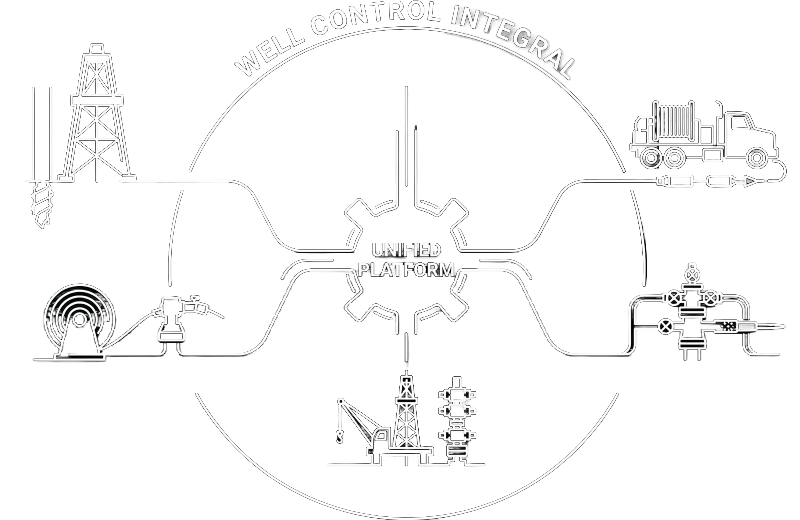
Accreditation validates the starting point. RuntimePhysics™ carries the same persistent state and deterministic response into crew rehearsal, procedure validation, HIL testing, digital twin workflows, and operational studies. This full-lifecycle approach aligns with IOGP Report 476 across drilling, completions, intervention, and abandonment.
Pressure, influx, fluid, barriers, equipment, and crew actions stay connected from detection through shut-in, circulation, and recovery. Decisions change the active well state rather than advancing a fixed script.
Pressure, flow, influx, fluids, barriers, and equipment state persist through the complete well-control event.
Shut-in, choke, pump, circulation, and recovery actions change the running physics and preserve their consequences.
Driller, supervisor, instructor, and connected controls work from the same authoritative pressure and barrier state.
The same deterministic RuntimePhysics™ extends from IADC-approved and IWCF-aligned training into drilling, MPD, intervention, procedure validation, HIL, digital twins, and operational studies.
WELL CONTROL SIMULATOR FAQ
Direct answers for training teams evaluating kick response, pressure control, accreditation workflows, connected controls, and deployment.
A well control simulator is a physics-based training environment for detecting influx, shutting in the well, controlling pressure, circulating safely, and recovering while pressure, flow, fluids, barriers, and equipment remain connected.
Teams can rehearse kick detection, shut-in, choke operation, circulation methods, barrier verification, surface and subsea equipment response, escalation, and recovery under changing well conditions.
Yes. Endeavor provides IADC-approved simulation content and supports IWCF-aligned well control training workflows, while extending the same RuntimePhysics™ into advanced rehearsal, procedure validation, HIL, and operational studies.
No. Pressure, influx, fluid, barrier, and equipment state persist, so each crew action changes the active well and carries its consequences into the next decision.
Yes. Driller controls, choke panels, PLCs, automation, and external systems can act against the same deterministic pressure and flow model for training and hardware-in-the-loop validation.
Deployments range from online and workstation access to portable multi-station systems, full crew simulators, and experience-center installations using the same underlying physics.