Interaction during drilling
Drillers, instructors, PLCs, automation, and external data can change the live well without breaking continuity.
Rehearse complete drilling operations against a continuously evolving well state. Change parameters, branch scenarios, connect real control systems, and compare outcomes without restarting the simulation.
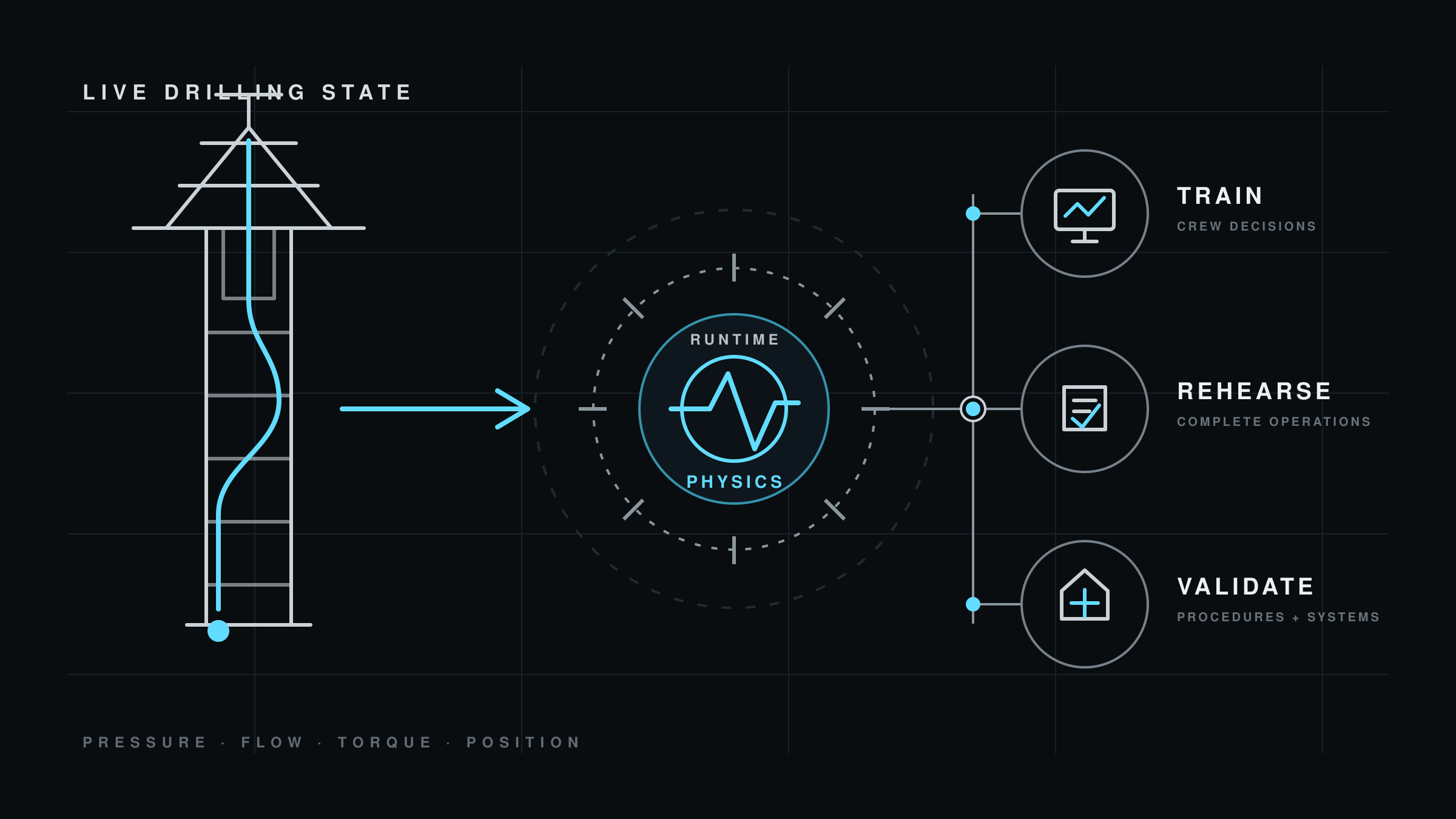
RuntimePhysics™ accepts new drilling inputs while execution continues. Change mud properties, pump rates, drillstring motion, geometry, or formation conditions and observe the physical response without resetting the well.
The Drilling Simulator maintains one continuously evolving representation of the well. Every driller action, control response, and physical change begins from the pressure, flow, cuttings, mechanics, and equipment state that exists now.
RuntimePhysics™ keeps the drilling model running independently from the interfaces used by drillers, instructors, automation, control systems, and connected operational data.
Drillers, instructors, PLCs, automation, and external data can change the live well without breaking continuity.
A deterministic runtime produces repeatable drilling results while still accepting live decisions and changing well conditions.
The drilling physics layer operates independently from the viewer, creating a stable foundation for laptops, full-scale simulators, and connected control systems.
Direct answers for drilling teams evaluating training, rehearsal, controls integration, and deployment.
It is a physics-based simulation environment for training, rehearsing, and validating drilling operations against one continuously evolving well state.
Teams can simulate drilling operations across hydraulics, hole cleaning, torque and drag, cementing, trajectory, pressure management, equipment behavior, and failure-mode studies.
No. RuntimePhysics™ accepts changes to fluid, geometry, parameters, and operating conditions while execution continues and the current state is preserved.
Yes. The platform can connect with controls and operational data for HIL validation, integrated workflows, and more realistic operator interaction.
Deployment can range from portable laptop and online access to integrated hardware, control-system, and HIL environments.
The model carries pressure, flow, equipment position, and other physical conditions forward, so each decision inherits the consequences of the last one.
Selected drilling simulations
Endeavor’s Drilling Simulator is supported by focused research spanning continuous well-state execution, long-distance multiphase hydraulics, drillstring mechanics, concurrent scenarios, and stable compute performance.
Change mud properties, pump rates, geometry, formation conditions, or drillstring motion without resetting the current well state.
Model pressure, flow, cuttings transport, rheology, and geometry as conditions evolve across long drilling intervals.
Run independent drilling branches while preserving deterministic timing, comparable initial conditions, and the same persistent execution model.
Keep hydraulic, mechanical, and well-state behavior stable as model detail, connected data, and scenario workload increase.
Begin with cloud or workstation access. Add tactile controls, team-based simulators, or full-scale hardware as requirements grow. Every deployment runs the same scenarios, physics, and operational state.


Stream RuntimePhysics™ to any supported device with no local simulator hardware required.
Explore Endeavor.One →Run full-fidelity planning, validation, and forensic analysis from a laptop-class system.
Explore Workstation →Purpose-built multi-station hardware for full-scale crew interaction and operational rehearsal.
Explore X1 →A semi-permanent cyber-chair simulator with four high-resolution displays, dual touch interfaces, and realistic joystick and switch controls.
Discuss X2 →Portable multi-station simulation hardware that moves from case to operation in minutes.
Explore X3 →Multi-user instruction, assessment, and collaborative workflows in a purpose-built environment.
Explore the Center →Move from the drilling simulator into pressure control, managed pressure drilling, RuntimePhysics™, and deployment without leaving the same operational model.
Tell us what you need to train, test, or de-risk. We’ll focus the conversation on the operation, physics, and deployment environment.